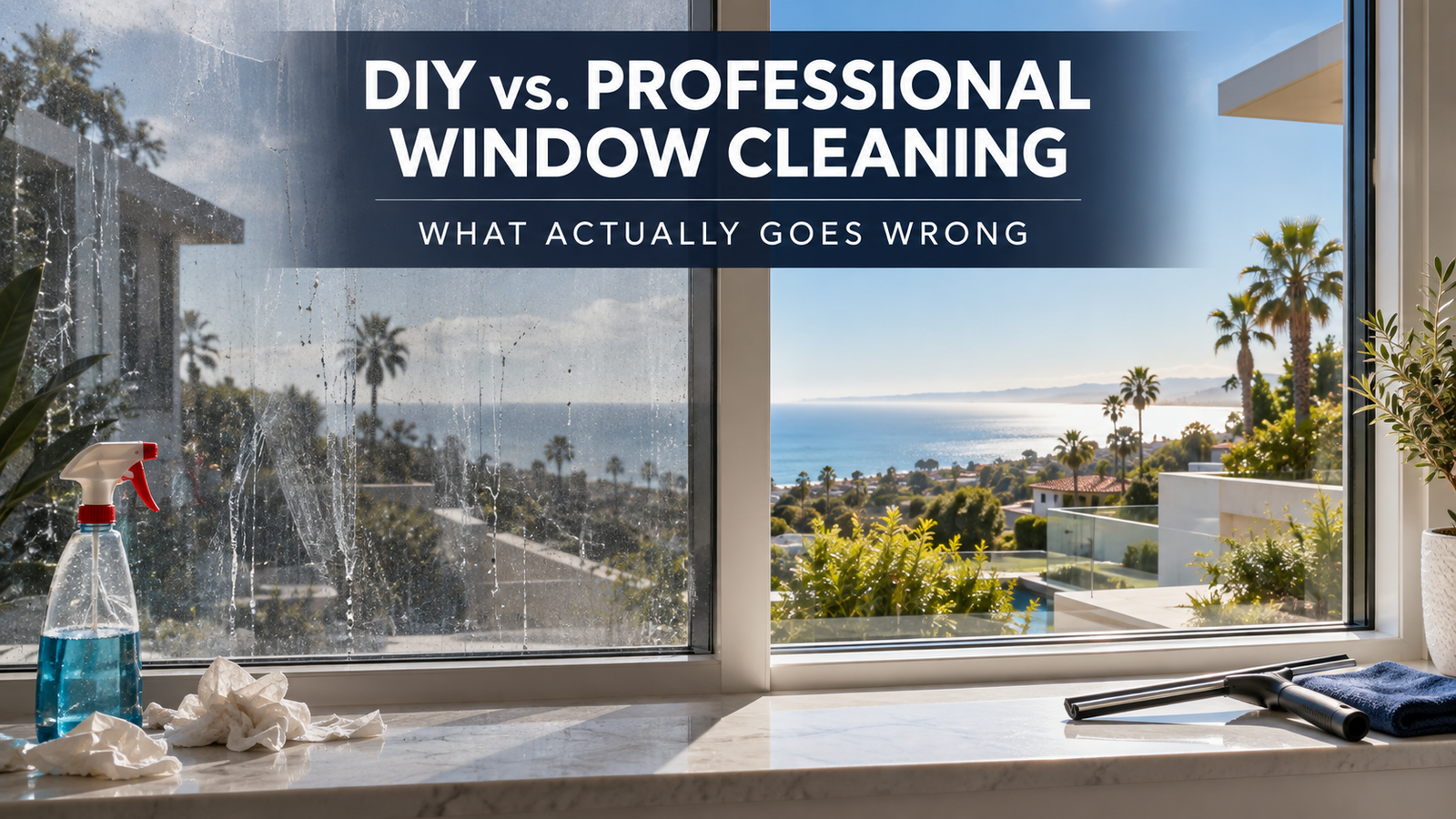
DIY vs. Professional Window Cleaning: What Actually Goes Wrong
Written by the Reliable Window Cleaning San Clemente team. Last updated September 9, 2026.
Most “DIY vs. professional” articles are sales pitches wearing a comparison headline. This one isn’t going to tell you DIY is dangerous or impossible, because for a lot of homes, it’s genuinely fine. What’s actually useful is looking at what goes wrong on both sides, based on real accounts from people who’ve done this for years and real complaints from homeowners who hired the wrong person.
Is DIY Window Cleaning Actually Worth It?
For ground-floor, easily reachable windows with plain glass, yes, DIY is usually worth it if you’re willing to learn real technique. For second-story, tinted, coated, or heavily neglected glass, the math changes fast, since a single mistake can cost more to fix than several professional cleanings combined.
The honest answer depends less on money and more on two things: your access, and your willingness to actually learn the technique instead of just buying a different spray bottle when the first one doesn’t work.
What Actually Goes Wrong With DIY Window Cleaning?
The most common DIY complaint is streaking that won’t go away no matter what product you try, and it’s almost never about the product. In a real discussion among working window cleaners, an experienced pro diagnosed a beginner’s persistent streaking down to three specific, fixable causes.
- Worn squeegee rubber. Even slightly worn edges leave inconsistent lines across the glass.
- Pressing down too hard. A very common beginner habit that makes streaking worse, not better.
- Not knowing “cutting in.” The technique of starting your squeegee stroke from the middle of the pane rather than dragging in from the edge.
None of these are solved by a better cleaning spray. They’re equipment condition and technique problems, which is exactly why streaks tend to persist even after someone gets frustrated and switches products two or three times.
How Much Does DIY Window Cleaning Actually Cost?
A basic DIY setup — scrubber, squeegee, microfiber cloths, bucket, and solution — typically runs $40 to $100. That sounds cheap next to a professional visit, but it doesn’t include your own time, which real estimates put at 2.5 to 4 hours for a full two-story home cleaned inside and out.
If your time is worth anything to you, that gap narrows fast. A professional cleaning for a comparable home commonly runs somewhere in the $150-$300 range depending on size and access — not far off from what two or three weekends of your own time might be worth, once you actually add it up instead of treating your time as free.
What Actually Goes Wrong When You Hire the Wrong Window Cleaner?
This side gets skipped in most “just hire a pro” content, but real homeowner complaints tell a different story. Property damage from an unvetted or careless cleaner is a real, documented risk, not a hypothetical scare tactic.
Real accounts from a homeowner forum describe:
- Broken roof tiles from a cleaner walking on the roof without care.
- Damaged lead flashing from a ladder set up without proper standoffs to protect it.
- Scratched window ledges from careless pole-scraper technique.
The pattern underneath all of them is the same: an under-qualified or uninsured cleaner has no real financial backstop if something goes wrong, and often no ongoing local reputation to protect either.
Do You Need a License to Clean Windows in California?
Standard residential window cleaning generally does not require a California contractor’s license, based on informal but consistent consensus among working professionals. Some related work — like larger pressure washing or construction cleanup jobs over a certain dollar threshold — may fall under different rules. For a definitive answer on a specific job, the California Contractors State License Board (CSLB) is the actual authoritative source, not a forum thread or a blog post, including this one.
What this means practically for you as a homeowner: a lack of a contractor’s license isn’t automatically a red flag for a window cleaner the way it might be for a roofer or an electrician. Insurance, not licensing, is the more relevant thing to verify for this specific service.
How Much Does Window Cleaning Insurance Actually Cost a Business?
Real industry data puts average general liability insurance for a window cleaning business at around $78 a month, or roughly $930 a year, typically with $1 million per occurrence and $2 million aggregate coverage limits. That’s a real, ongoing cost a legitimate company is actually paying, not just a line on a website.
Interestingly, those standard limits are the same ones most legitimate window cleaning businesses carry, ours included. That’s not a coincidence, or something we adjusted to sound impressive — it’s simply the industry-standard coverage level for this kind of work, which makes it easy to verify a company against: if a business claims wildly different numbers, or can’t produce a certificate at all, that’s worth a second look.
What’s the Real Risk of DIY on Coated or Tinted Glass?
Scratches, clouding, and permanent damage to tinted or Low-E coatings are the real risk of DIY on anything beyond plain, uncoated glass. Aggressive scraping, the wrong chemical, or even a stiff scrub pad can permanently damage a coating in a way that’s not repairable, unlike a scratch on plain glass.
This is the same caution we cover in more technical depth on our New Construction & Post-Construction Window Cleaning page, where the stakes are higher because paint or adhesive is often involved on top of the coating risk.
Is DIY Safe for Second-Story or Hard-to-Reach Windows?
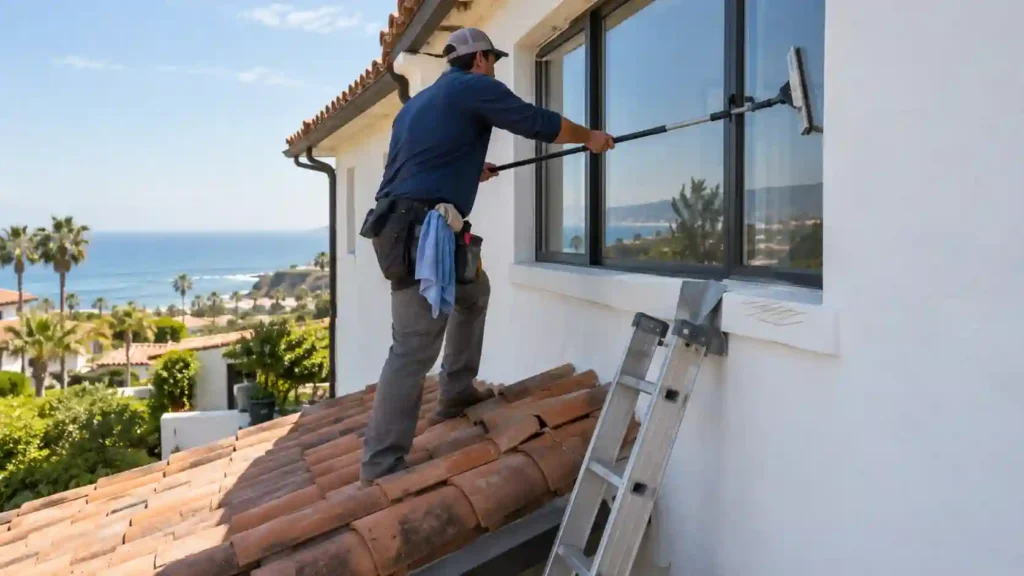
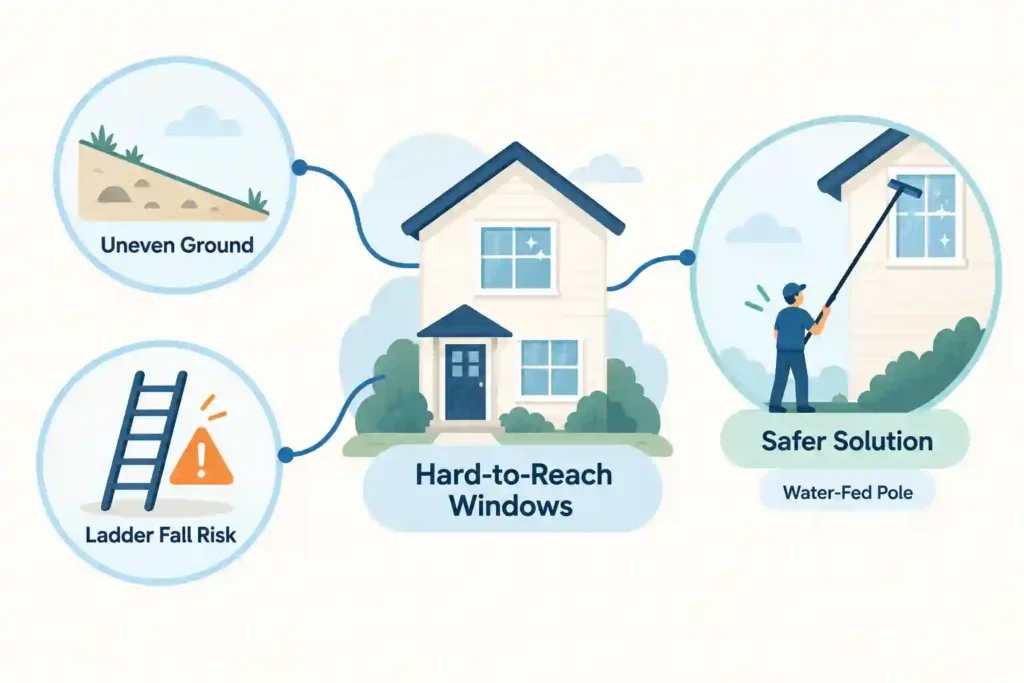
Ladders on uneven or sloped ground carry real fall risk that’s about the ground, not just the height. This is a genuinely different problem from a flat driveway, which is why water-fed pole systems exist as a real professional alternative rather than a upsell. Our Hard-to-Reach & Second-Story Window Cleaning page covers how that access problem is actually solved without a ladder on unstable ground.
How Do I Decide Between DIY and Hiring a Professional?
Use your access and glass type as the deciding factor, not just the price difference. Plain, ground-level glass favors DIY if you’re willing to learn real technique. Second-story, coated, tinted, or long-neglected glass favors hiring out, since the cost of a mistake there is usually higher than the cost of the cleaning itself.
| Situation | DIY Makes Sense | Hiring Out Makes Sense |
|---|---|---|
| Ground-floor, plain glass | Yes, if you learn real technique | Only if you’d rather not spend the time |
| Second-story or hillside access | Rarely — ladder risk on uneven ground | Yes, water-fed pole avoids the ladder entirely |
| Tinted or Low-E coated glass | Risky — wrong product can cause permanent damage | Yes, professionals know what each coating tolerates |
| Heavy, long-neglected buildup | Often frustrating and slow | Yes, usually faster and less likely to scratch the glass |
| One-time light touch-up | Yes, low risk either way | Optional |
How Do I Vet a Window Cleaner If I Decide to Hire One?
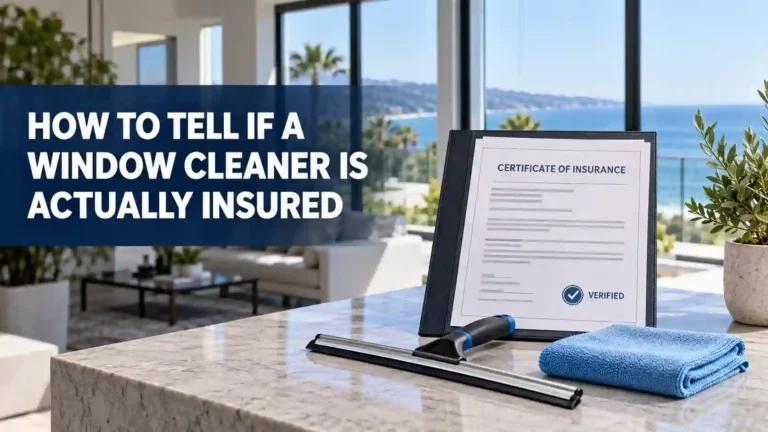
Ask for a certificate of insurance and actually confirm it, not just take the claim at face value. Verifying insurance is the single highest-value step most homeowners skip entirely, and it’s detailed step by step in our companion post, How to Tell If a Window Cleaner Is Actually Insured.
Final Verdict: So Which Should You Actually Choose?
If your windows are ground-level, plain glass, and you’re genuinely willing to learn the real technique — worn-rubber checks, lighter pressure, cutting in from the middle of the pane — DIY holds up fine, and the $40-100 tool cost pays for itself over a few cleanings. If you’ve got second-story glass, coated windows, or you’ve already tried DIY and the streaks aren’t a technique problem you feel like solving, hiring out is the more reliable option, as long as you actually vet who you’re hiring rather than picking whoever answers the phone first.
Either way, insurance and technique matter more than the DIY-vs-professional label itself. A careless “professional” with no real coverage can do more damage than a careful DIYer with the right instructions.
Want a real price for your specific home instead of guessing? Our Window Cleaning Cost Guide breaks down real pricing by home size, or you can request a free estimate directly.
FAQs
Can I damage my windows by cleaning them myself? Yes, mainly through aggressive scraping, the wrong chemical on coated or tinted glass, or years of accumulated scratching from abrasive pads. Plain glass is fairly forgiving; coated glass is not.
How long does it actually take to clean windows yourself? For a full two-story home, inside and out, realistic estimates run 2.5 to 4 hours. Ground-floor-only jobs are faster, often under 90 minutes for around 10 windows.
Is it cheaper to hire a professional than to do it myself? Not always in raw dollars, since basic DIY tools cost far less than a single professional visit. It depends on how much your own time is worth and how many times a year you’re doing this.
Related Reading
How to Tell If a Window Cleaner Is Actually Insured · Hard-to-Reach & Second-Story Window Cleaning · New Construction & Post-Construction Window Cleaning · Window Cleaning Cost Guide · Window Cleaning FAQs