How to Tell If a Window Cleaner Is Actually Insured
Written by the Reliable Window Cleaning San Clemente team. Last updated September 9, 2026.
“We’re fully insured” costs nothing to put on a website. The real question isn’t whether a company claims it — it’s whether you’d know how to check, and whether you’d catch it if the coverage had lapsed, was too low, or never existed at all.
How Do I Actually Verify a Window Cleaner’s Insurance?
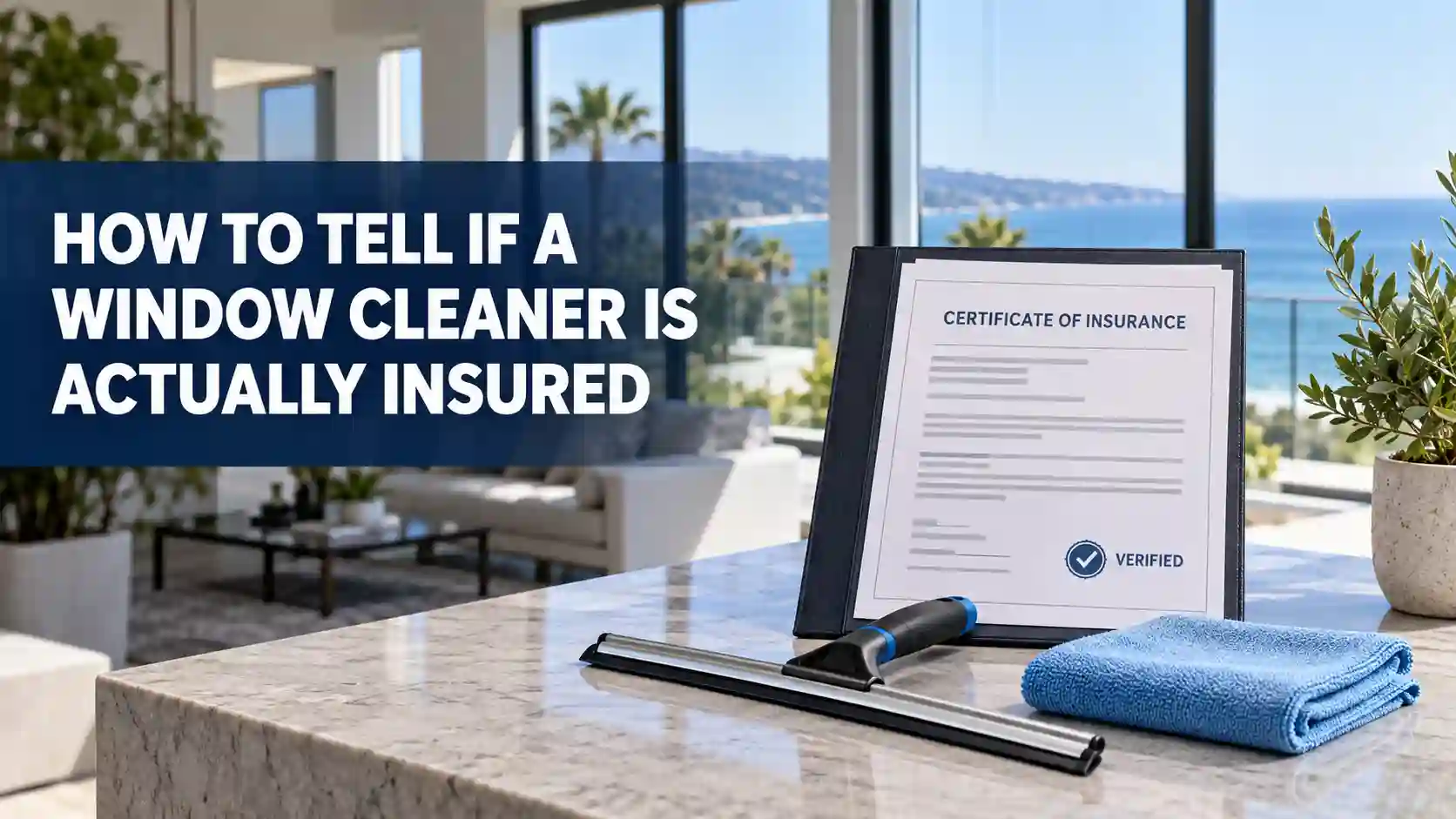
Ask for a Certificate of Insurance (COI), check that it names the correct business and coverage amount, then call the insurance agent listed on it to confirm the policy is still active. That last step is the one almost nobody does, and it’s the only way to know the coverage is real right now, not just real on the date the document was printed.
Here’s each part in more detail, since skipping any one of them defeats the point.
What Should a Real Certificate of Insurance Actually Show?
A legitimate COI should show the correct legal business name matching who you’re actually hiring, policy numbers for general liability (and workers’ comp if there’s a crew), a liability coverage amount commonly at least $1 million, and current, unexpired effective dates. A document missing any of these isn’t proof of much.
- Correct legal business name — not a similar-sounding one, and not just a first name.
- Policy number, not just a logo and a signature.
- Coverage amount, typically $1 million per occurrence as an industry baseline.
- Effective and expiration dates that are actually current, not expired months ago.
Why Does It Matter If I Actually Call the Insurance Agent?
Because a document doesn’t update itself if a policy lapses, and it can be outdated or altered without you having any way to know just by looking at it. A five-minute call to the agent or company listed on the COI is the only way to confirm the policy is genuinely active today, not just printed to look that way at some point in the past.
This single step is what separates real verification from just collecting paperwork. Most homeowners never do it, which is exactly why it’s worth the five minutes.
What Does Real Window Cleaning Insurance Actually Cost a Business?
Real industry data puts average general liability insurance for a window cleaning business at around $78 a month, or roughly $930 a year, with standard limits of $1 million per occurrence and $2 million aggregate. That’s a genuine, ongoing operating cost a legitimate company is actually paying every month, not a one-time fee or a formality.
Knowing this helps you judge a quote that seems unusually low. Insurance isn’t the biggest line item in a company’s costs, but a business skipping it entirely can afford to undercut a properly insured competitor, and that gap has to come from somewhere.
What About Workers’ Compensation?
If more than one person is coming to your property, ask about workers’ compensation specifically, not just general liability. General liability covers damage to your property. Workers’ comp covers an employee injured while working on it — and without it, an injured worker can potentially hold you, the homeowner, responsible instead of the company’s insurer.
Requirements vary by crew size and by state, so if you’re unsure whether it applies to a specific company, just ask them directly rather than assuming either way.
Does a Window Cleaner Need a Contractor’s License in California?
Standard residential window cleaning generally does not require a California contractor’s license, based on consistent informal consensus among working professionals in the trade. Some related work, like larger pressure-washing or construction cleanup jobs over a certain dollar threshold, may fall under different rules. For a definitive answer, the California Contractors State License Board (CSLB) is the real authoritative source, not a blog post or a forum thread.
What this means for you: a lack of a contractor’s license isn’t automatically a red flag for a window cleaner the way it might be for other trades. Insurance is the more directly relevant thing to verify for this specific service.
What Actually Happens If My Cleaner Isn’t Insured and Something Breaks?
You can end up personally responsible for repair costs that a properly insured company would have absorbed. Real accounts from homeowner forums describe exactly this outcome: broken roof tiles, damaged lead flashing from an unprotected ladder, and scratched window ledges, all discovered only after the job was done and the cleaner was already gone.
Insurance isn’t paperwork for its own sake. It’s the difference between “this got fixed at no cost to me” and “this is now my problem to pay for.”
What Other Red Flags Should I Watch For Besides Insurance?
Hesitation or excuses about providing a COI, verbal promises instead of an actual document, and no established local presence are all real warning signs worth paying attention to. A company that’s careless with your property during the estimate itself — walking through your yard, handling gates, or setting equipment down without care — is usually a preview of how careful they’ll be once they’re actually working.
- Ask for references, not just star ratings.
- Prefer a company with an established local route over an anonymous online-only listing.
- Notice how they treat your property before the job even starts.
Insurance Verification: A Quick Checklist
| Step | What You’re Confirming |
|---|---|
| Request a COI before booking | The company is willing to provide real documentation |
| Check the business name matches | The policy actually covers who you’re hiring |
| Check the coverage amount | Commonly at least $1 million per occurrence |
| Check the expiration date | The policy hasn’t lapsed |
| Call the insurer listed on the COI | The policy is genuinely active right now |
| Ask about workers’ comp if there’s a crew | You’re not liable for an on-site injury |
What Does This Look Like for Your Company Specifically?
We carry general liability insurance at $1 million per occurrence and $2 million aggregate, along with workers’ compensation coverage for our crew, and we’ll provide a certificate of insurance before work starts if you’d like one. Confirming it with our insurer directly is exactly the step we’d encourage, not one we’d rather you skip.
Final Verdict: Is This Really Worth the Effort?
Yes, and it takes less time than most people assume — request the document, glance at four things on it, and make one phone call. That’s the entire process. Skipping it doesn’t usually cost you anything, until the one time it does, and by then the company that caused the damage is often already gone. A five-minute check before booking is cheap insurance against a much more expensive problem.
If you’re comparing quotes and want a real price to weigh against everything above, our Window Cleaning Cost Guide breaks down real pricing by home size, or you can request a free estimate directly.
FAQs
Is it rude to ask a window cleaner for proof of insurance? No. A legitimate company expects this question and will provide a COI without hesitation. Treat any pushback or excuses as useful information about how the rest of the job might go.
What’s the difference between general liability and workers’ compensation? General liability covers damage to your property. Workers’ compensation covers an employee who gets injured while working on your property. You want both confirmed if more than one person is coming to your home.
Does a cheap quote mean a company probably isn’t insured? Not always, but it’s worth asking directly. Real insurance costs a legitimate business real money every month, so an unusually low quote is sometimes, though not always, a sign that cost was cut somewhere.
Related Reading
DIY vs. Professional Window Cleaning: What Actually Goes Wrong · Window Cleaning Cost Guide · Window Cleaning FAQs