
Why Coastal Windows Get Hazy Faster Than Inland Glass
Written by the Reliable Window Cleaning San Clemente team. Last updated September 9, 2026.
If you’ve lived both near the coast and further inland, you’ve probably noticed windows that stayed clean for months inland need attention every few weeks on an ocean-facing home. That’s not a coincidence, and it’s not just “more wind.” There’s a real, explainable mechanism behind it.
Why Do Coastal Windows Get Hazy So Much Faster Than Inland Glass?
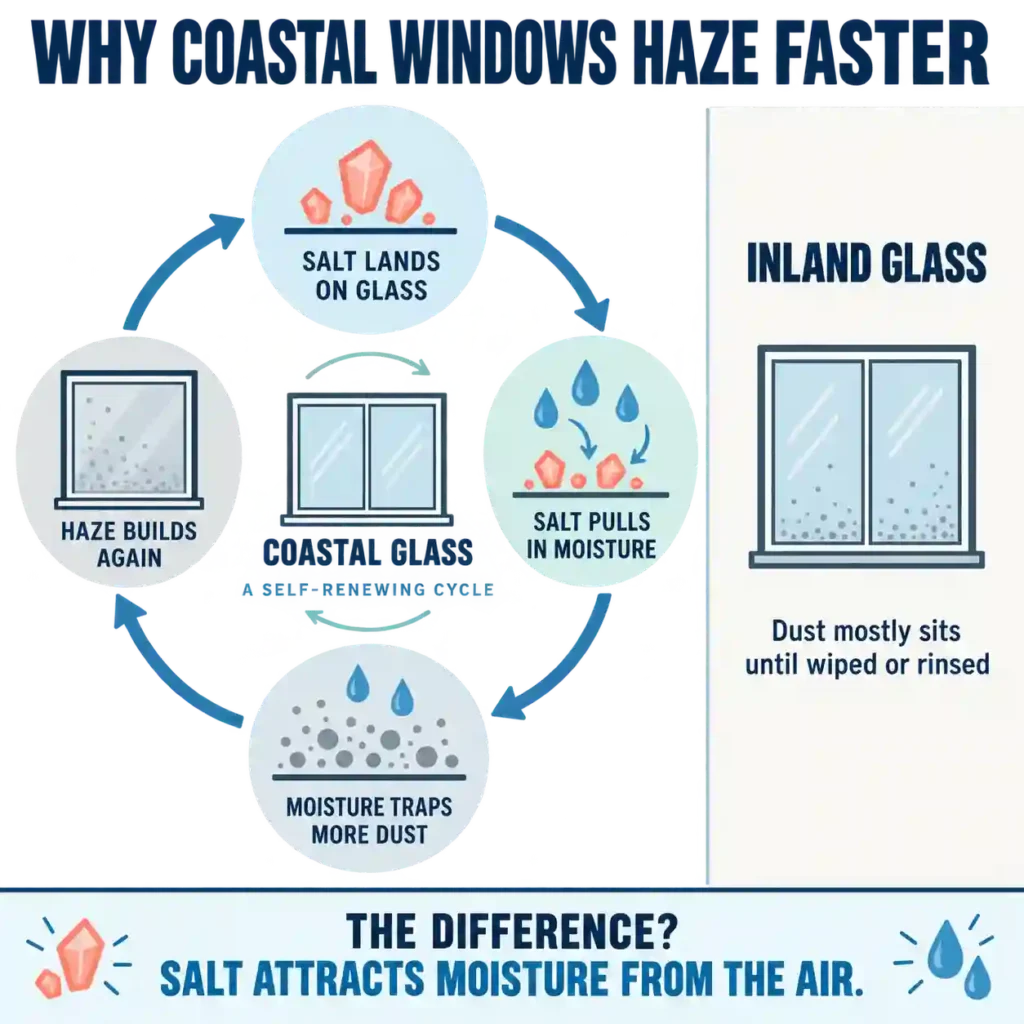
Coastal glass deals with salt residue that actively pulls moisture from the air, on top of the same dust and mineral buildup inland homes get. That combination creates a faster, self-renewing haze cycle that ordinary inland dirt simply doesn’t have, since inland dust mostly just sits inert until it’s rinsed or wiped away.
The rest of this comes down to one property of salt that most window-cleaning advice never mentions.
What Makes Salt Residue Different From Regular Dirt?
Sea salt is hygroscopic, meaning it actively absorbs and holds onto moisture from the air rather than sitting as an inert, dry residue. Once salt spray settles on glass, it stays slightly damp longer than the rest of the surface, and that dampness does two things: it gives new airborne dust something to stick to, and it keeps reabsorbing humidity even after the glass looks dry.
That’s a meaningfully different process than plain dust, which needs actual new deposits to build up. Salt residue can look worse again the next humid morning without a single new particle landing on the glass.
Does Morning Fog or Marine Layer Make This Worse?
Yes, and there’s real physics behind why. Condensation forms whenever a surface cools below the air’s dew point — the temperature at which air can no longer hold its moisture as vapor. Glass is often the coldest surface on a house overnight, and on a humid coastal morning, that’s enough to reactivate the moisture-holding salt residue already sitting there, even with no new salt spray at all.
This is why a window can look hazier on a foggy coastal morning than it did the evening before, without anything “new” happening — the existing residue is simply pulling in ambient moisture again.
How Fast Can Wind Actually Recoat a Clean Window?
Real accounts from working window cleaners describe wind-driven salt spray recoating freshly cleaned glass within hours during a heavy onshore wind event, not days or weeks. That’s an entirely different timeline than the slow, weeks-to-months buildup pattern that governs inland dust.
Some manufacturers of coastal-rated window glass explicitly recommend cleaning at least every three months in salt-air zones, specifically because of how fast this compounds compared to the roughly annual cleaning that holds up fine on many inland homes.
Is It Just Salt, or Is Hard Water Making It Worse Too?
Both, and they stack on top of each other. Irrigation overspray and rainwater carry dissolved calcium and magnesium, which leave mineral residue behind as the water evaporates. That happens everywhere, coastal or not — but on a coastal home, it’s compounding with the salt cycle instead of being the only thing on the glass.
Our Hard Water Stain & Salt Film Removal page covers how to tell which one you’re actually looking at, since the removal method is different for each, and what happens once either one has been left long enough to etch the glass rather than just sit on the surface.
Does This Only Affect Homes Right on the Water?
No, but exposure drops off with distance and elevation. Homes directly ocean-facing or on a bluff feel the full hygroscopic-salt-plus-wind cycle described here. A few miles inland — around San Juan Capistrano, for example — the dominant problem shifts to dust and Santa Ana wind events rather than direct salt spray, covered in more detail on our San Juan Capistrano page.
Elevation matters too. A hillside or bluff-top home often gets hit harder than a sheltered street a few blocks back, simply because there’s less around to block the wind and the salt it’s carrying.
Why Does This Matter More in Some Seasons Than Others?
Coastal haze isn’t seasonal in the way inland dust is — it runs on weather events instead of a calendar. Wind events and marine layer mornings can happen across most of the year here, which is exactly why a single “spring cleaning” schedule leaves long gaps where salt film gets a running start. Our post on the best time of year to clean windows in a coastal climate breaks this down month by month if you want the full seasonal picture.
What Actually Removes Coastal Haze Once It’s There?
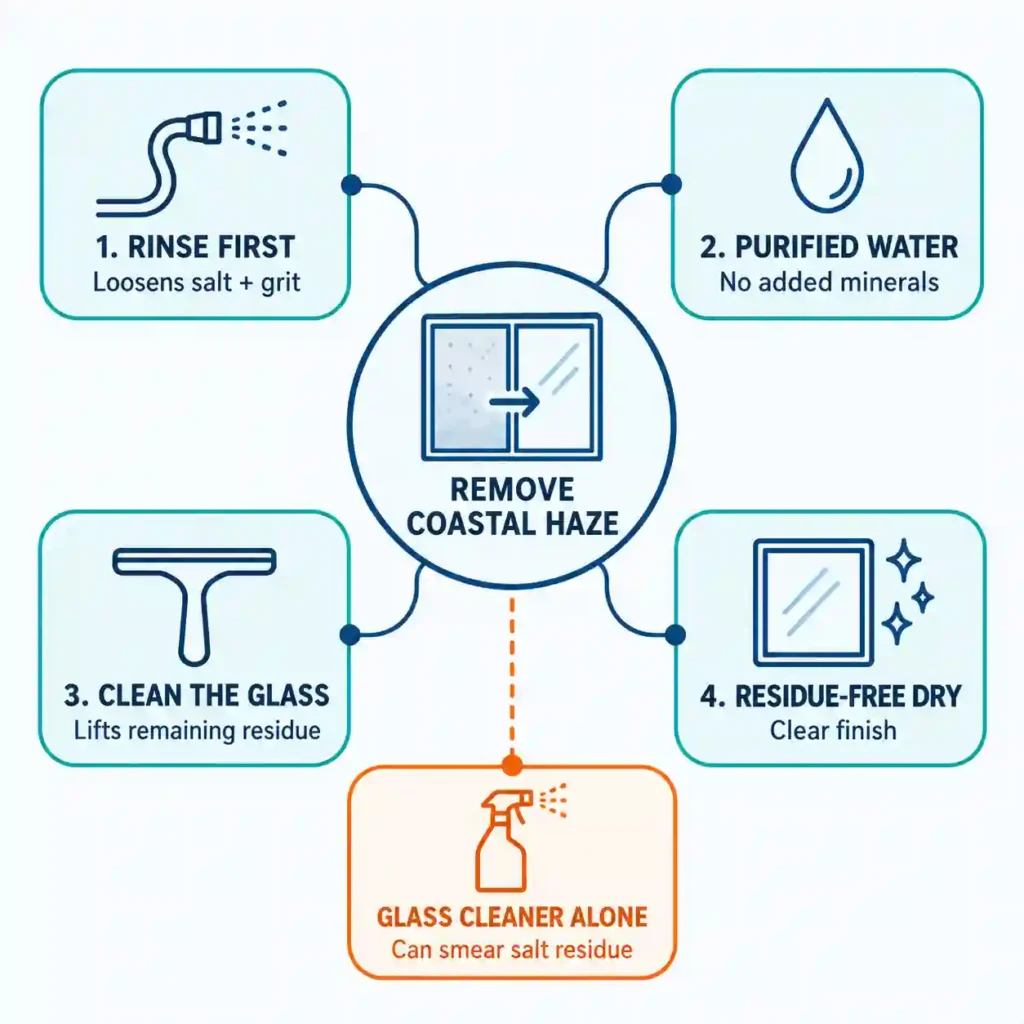
A thorough rinse to knock loose salt and grit off first, followed by cleaning with purified or deionized water, works well because mineral-free water doesn’t leave its own residue behind as it dries. Regular glass cleaner alone often just smears salt residue around instead of lifting it, which is a common reason people feel like their cleaning “didn’t really work.”
Coastal vs. Inland Glass: A Quick Comparison
| Coastal (Ocean-Facing) | Inland | |
|---|---|---|
| Main residue | Salt film (hygroscopic, self-renewing) plus hard water | Dust and hard water only |
| Rebuild speed after cleaning | Can happen within hours after a wind event | Weeks to months |
| Worst conditions | Onshore wind events, humid mornings | Dry, dusty stretches, Santa Ana wind season inland |
| Recommended cleaning interval | Roughly every 3-4 months on directly exposed glass | Often fine annually |
Final Verdict: What This Actually Means for Your Windows
The haze isn’t in your head, and it isn’t a sign you’re doing something wrong. Coastal glass is genuinely dealing with a different, faster-cycling problem than inland glass, driven by salt’s ability to keep pulling moisture out of the air long after it first landed. Understanding that mechanism is what should actually change your cleaning schedule — not “clean when it looks dirty,” but watching for wind events and humid mornings as the real triggers.
If you want to see what a cleaning schedule built around that reality actually costs, our Window Cleaning Cost Guide has real pricing by home size, or you can request a free estimate for your specific property.
FAQs
Will my coastal windows always look a little hazy no matter how often I clean them? Not if you clean on a schedule that matches your actual exposure rather than a generic annual one. Directly ocean-facing glass tends to need attention every three to four months to stay ahead of the salt cycle described here.
Does living further from the beach actually help, or is it the same everywhere? It genuinely helps. Exposure drops off with distance and with anything blocking direct wind, like other buildings or trees. A sheltered inland-facing window collects far less than an unobstructed oceanfront pane.
Can I prevent salt film from building up in the first place? Not entirely, but rinsing exposed glass after a heavy wind event and keeping to a shorter cleaning interval both help keep it from compounding into the kind of buildup that eventually risks etching the glass.
Related Reading
Hard Water Stain & Salt Film Removal · Best Time of Year to Clean Windows in a Coastal Climate · Window Cleaning in San Juan Capistrano · Window Cleaning Cost Guide