

Best Time of Year to Clean Windows in a Coastal Climate
Written by the Reliable Window Cleaning San Clemente team. Last updated September 9, 2026.
If you’ve searched for the best time of year to clean your windows, you’ve probably landed on the same advice a dozen times: clean in spring, pick a mild day, avoid direct sun. That advice isn’t wrong. It’s just written for a place that doesn’t have an ocean next door.
Live near the coast, in San Clemente or anywhere along this stretch of Orange County, and your windows are dealing with something most of the country never has to think about: salt air, marine fog, and wind events that can undo a cleaning in hours instead of months. This guide covers what actually changes, month by month, when your home faces the Pacific.
When Is the Best Time of Year to Clean Windows on the Coast?
There isn’t one best month. Coastal homes face three separate conditions that peak at different times: spring pollen, summer marine layer, and fall Santa Ana winds. Instead of picking one season, watch for events — clean after a windy stretch, take advantage of humid overcast mornings, and don’t rely on a single yearly cleaning to carry you through all three.
That’s the short version. The rest of this guide walks through why, using real, named weather patterns specific to this part of the California coast, not generic seasonal advice borrowed from a national blog.
Why Doesn’t the Generic “Clean in Spring” Advice Work Here?
Generic advice assumes one slow dirt cycle: grime builds up gradually over winter, and spring is your one shot to clear it before pollen season. That’s a reasonable model inland. On the coast, it misses two things entirely — a marine layer season that runs most of the summer, and a fall wind season that can re-coat your glass faster than any inland dust ever would.
A home in Talega or Forster Ranch, up in the hills a few miles back from the water, still gets some of this. A home right along the coast near the Pier Bowl or T-Street gets it constantly, since there’s nothing between the glass and the ocean air.
What Temperature Is Actually Best for Cleaning Windows?
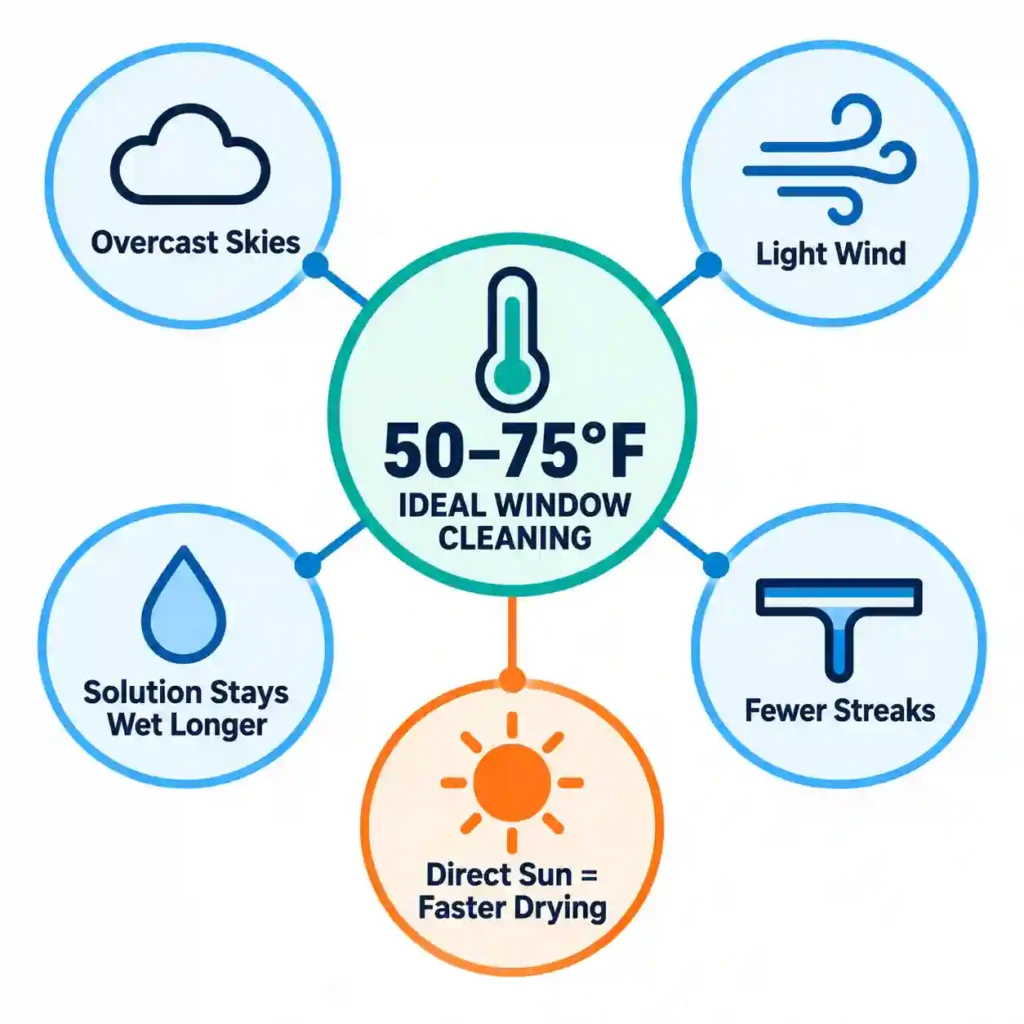
Most professional guidance points to roughly 50 to 75°F, with overcast skies and light wind. In that range, cleaning solution stays wet long enough to loosen dirt before you squeegee it off. Outside that range — especially in direct sun — the solution can dry before you finish the stroke, which is what actually causes streaking.
This isn’t just a comfort preference. It’s about giving the water enough time to do its job before it evaporates off the glass.
Why Do Windows Streak When You Clean Them in Direct Sun?
Direct sunlight heats the glass surface well past the air temperature around it, and hot glass dries cleaning solution almost instantly, leaving mineral and soap residue behind before you can wipe it away clean. That fast-drying residue is what shows up as streaks, not a bad cleaning product.
Here’s the mechanism in more detail, since it explains why timing genuinely changes your results, not just your comfort:
- Glass surface temperature can climb well past 120°F in direct sun, because solar radiation pushes the glass 20 to 30 degrees hotter than the surrounding air.
- Humidity changes how fast water disappears. At around 20% relative humidity, water evaporates roughly twice as fast as it does at 60% humidity.
- Wind shrinks your working time further. A light breeze can cut the time you have to squeegee a pane clean down to just a few seconds before the solution flashes off.
Put those three together on a hot, dry, windy afternoon, and you’re fighting physics, not just bad luck.
What Is “June Gloom” and How Does It Affect Window Cleaning in San Clemente?
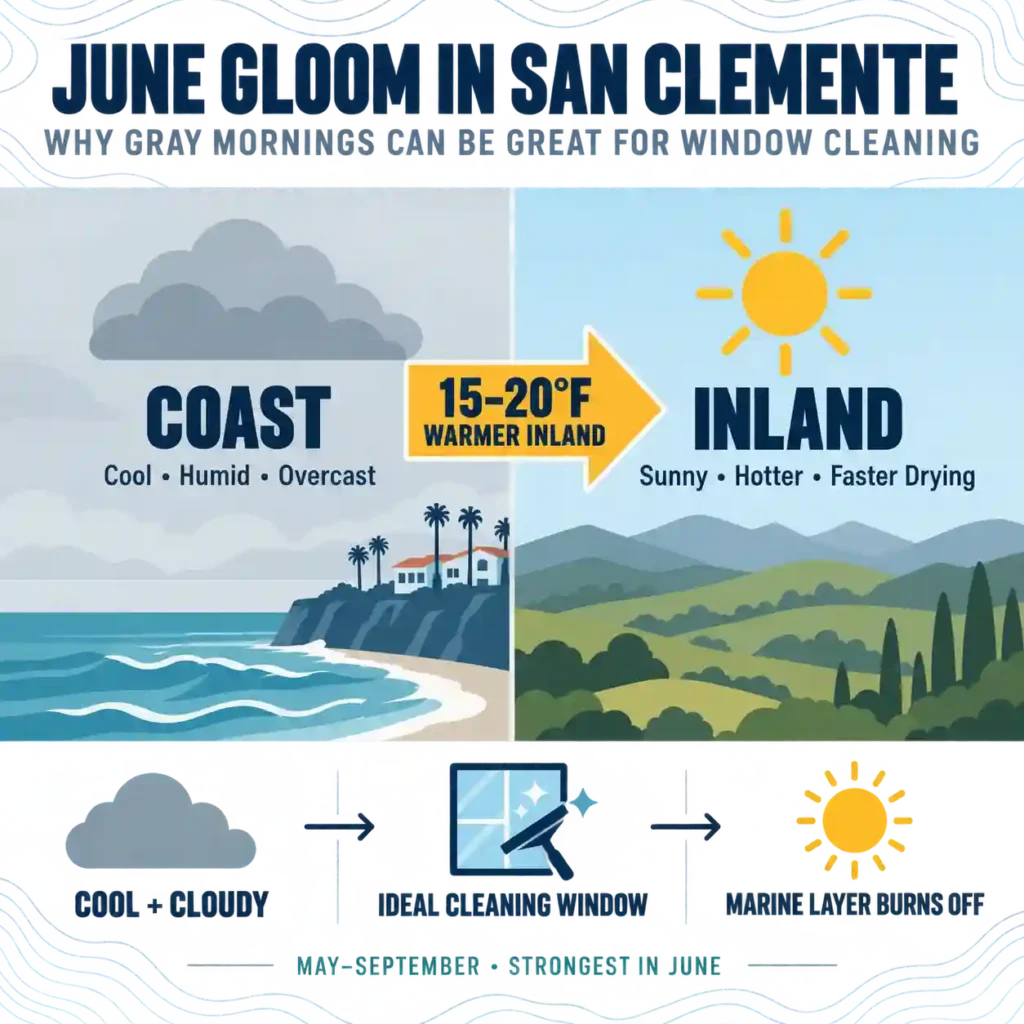
June Gloom is a real marine layer weather pattern along the Southern California coast, running roughly May through September and hitting hardest in June. It brings cool, humid, overcast mornings to the coast even when it’s 15 to 20 degrees warmer just a few miles inland. For window cleaning, those conditions — overcast, cooler, humid — are close to ideal, even though the calendar says summer.
If you’ve ever wondered why the coast feels gray and damp in June while Talega or San Juan Capistrano sits under full sun, this is why. AccuWeather has a good explainer on how the marine layer forms if you want the full meteorology.
Practically, this means the months most seasonal advice tells you to avoid — because inland summer heat wrecks a cleaning job — are often some of the better windows for coastal cleaning, at least on the mornings before the marine layer burns off.
What Are Santa Ana Winds and Why Do They Matter for Your Windows?
Santa Ana winds are hot, dry offshore winds that typically start in late September and continue through winter, with September through November carrying the highest wind and fire risk. Near the coast, these events can drive dust and salt spray onto glass fast enough to haze a freshly cleaned window within hours, not weeks.
This is the piece almost no generic window-cleaning article accounts for, because most of the country doesn’t have anything like it. If you time your one annual cleaning for early fall because “there’s less rain,” you may be cleaning right before the single windiest, driest stretch of the year works against you.
Homes higher up — bluff-top properties, hillside streets near Shorecliffs, or anywhere with a clear, unblocked path to the wind — tend to feel this faster than a sheltered, tree-lined block a few streets back.
Does Pollen Season Affect Coastal Homes Too?
Yes. California’s allergy season often starts as early as late January and peaks again in April and May, then again in September. Coastal homes get this same pollen load, plus the salt film building underneath it, so a light dusting that would just rinse off inland can bake into a stubborn, streaky layer here if it sits through a sunny afternoon.
The practical takeaway: treat a visible pollen film as a reason to clean soon, not something to wait out until your “usual” spring cleaning date. The longer it sits in the sun, the more it behaves like the mineral buildup covered on our Hard Water Stain & Salt Film Removal page, rather than something a quick rinse handles.
How Often Should Coastal Homes Actually Get Their Windows Cleaned?
More often than the standard once-a-year schedule that works fine inland. Because pollen, marine layer humidity, and Santa Ana wind events peak at different times and don’t overlap, a single yearly cleaning leaves long stretches where salt film and mineral deposits can build up mostly unchecked, especially on ocean-facing glass.
There’s no single number that fits every home — a sheltered inland-facing window in Rancho San Clemente collects buildup a lot slower than an oceanfront pane near the Pier. As a general guide, many coastal homeowners find a schedule closer to every three to four months holds up better than waiting a full year, particularly on windows that face the water directly.
Does Time of Day Matter as Much as Time of Year?
Yes, for the same reason time of year does. Morning and late afternoon keep glass further from its hottest, driest point in the day, giving cleaning solution more time to work. Midday sun on south- or west-facing glass is the toughest window to clean well, regardless of the season.
If you’re doing this yourself, it’s worth treating sun-facing glass and shaded glass as two separate jobs within the same visit — clean the shaded side whenever, but save direct-sun panes for early morning or once the sun has moved off them.
Do Hillside or Second-Story Windows Need Different Timing?
The same seasonal logic applies, but wind exposure is usually worse the higher up you go, since there’s less around to block it. Hillside and bluff-top homes, and second-story glass in general, often show salt buildup and dust faster than ground-level windows on the same street.
This is also where DIY gets harder to keep up with, since re-cleaning upper-story glass every few weeks after each windy stretch isn’t realistic without the right equipment. Our Hard-to-Reach & Second-Story Window Cleaning page covers how we handle that access safely, using water-fed pole systems instead of a ladder on uneven, sloped ground.
A Quick Reference: San Clemente’s Coastal Window-Cleaning Calendar
| Time of Year | What’s Happening | Effect on Windows | What to Do |
|---|---|---|---|
| Jan–Mar | Winter storms, early pollen start | Rain buildup, first pollen dusting | Clean after storms pass, not before one |
| Apr–May | Spring pollen peak, irrigation restarts | Pollen film plus fresh mineral overspray | Clean once pollen is visible, don’t wait for “spring cleaning day” |
| May–Sep | May Gray / June Gloom marine layer | Cooler, humid, overcast mornings | Good cleaning window, especially early in the day |
| Sep–Nov | Santa Ana wind season begins | Dust and salt spray can haze glass within hours | Clean after a wind event calms, not before one |
| Sep | Second pollen peak overlaps early Santa Ana winds | Two problems stacking at once | Watch conditions closely this month |
| Dec | Winter rain returns | Rinses light buildup, but heavy grime still streaks | Fine to clean, same rule: after rain, not right before |
Final Verdict: What We’d Actually Tell You to Do
Stop planning your window cleaning around a season, and start planning it around events. A single spring cleaning, the advice you’ll find almost everywhere else, leaves your glass exposed to an entire marine layer season and a full Santa Ana wind season before its next scheduled visit. On the coast, that gap is exactly where salt film, pollen residue, and mineral buildup get a running start.
The practical version: clean after a Santa Ana wind event passes rather than before one, take advantage of May-through-September marine layer mornings when you can, treat a visible pollen film as a trigger to clean rather than something to wait out, and plan on a shorter overall interval than the standard yearly schedule if your home faces the ocean directly.
If you want to see what a more frequent coastal schedule actually costs compared to a once-a-year cleaning, our Window Cleaning Cost Guide breaks down real pricing by home size. And if you’d rather not track wind events and marine layer mornings yourself, request a free estimate and we’ll work a realistic schedule around your home’s actual exposure.
FAQs
Can I clean my windows in winter in San Clemente? Yes. Winter storms bring real rain, and cleaning after a storm passes works well, since rain on already-clean glass mostly rinses it. Just avoid cleaning right before a storm, since rain on dirty glass adds streaking instead of removing it.
What happens if I only clean my windows once a year? You’ll likely catch whichever season you scheduled around, but the other two coastal conditions — marine layer humidity and Santa Ana wind events — will have months to work against your glass before the next cleaning. That’s usually when hard water spots and salt film have the most time to set in.
Is professional cleaning worth it for coastal salt film, or can I keep up with it myself? Light, fresh salt film is manageable yourself with the right rinse and technique. Once buildup has been sitting for a while, or your home has hard-to-reach upper-story glass exposed to wind, professional equipment and a set schedule usually keep ahead of it more reliably than occasional DIY cleanings.
Related Reading
Hard Water Stain & Salt Film Removal · Hard-to-Reach & Second-Story Window Cleaning · Window Cleaning Cost Guide · Coastal Window Cleaning · Window Cleaning in San Juan Capistrano